
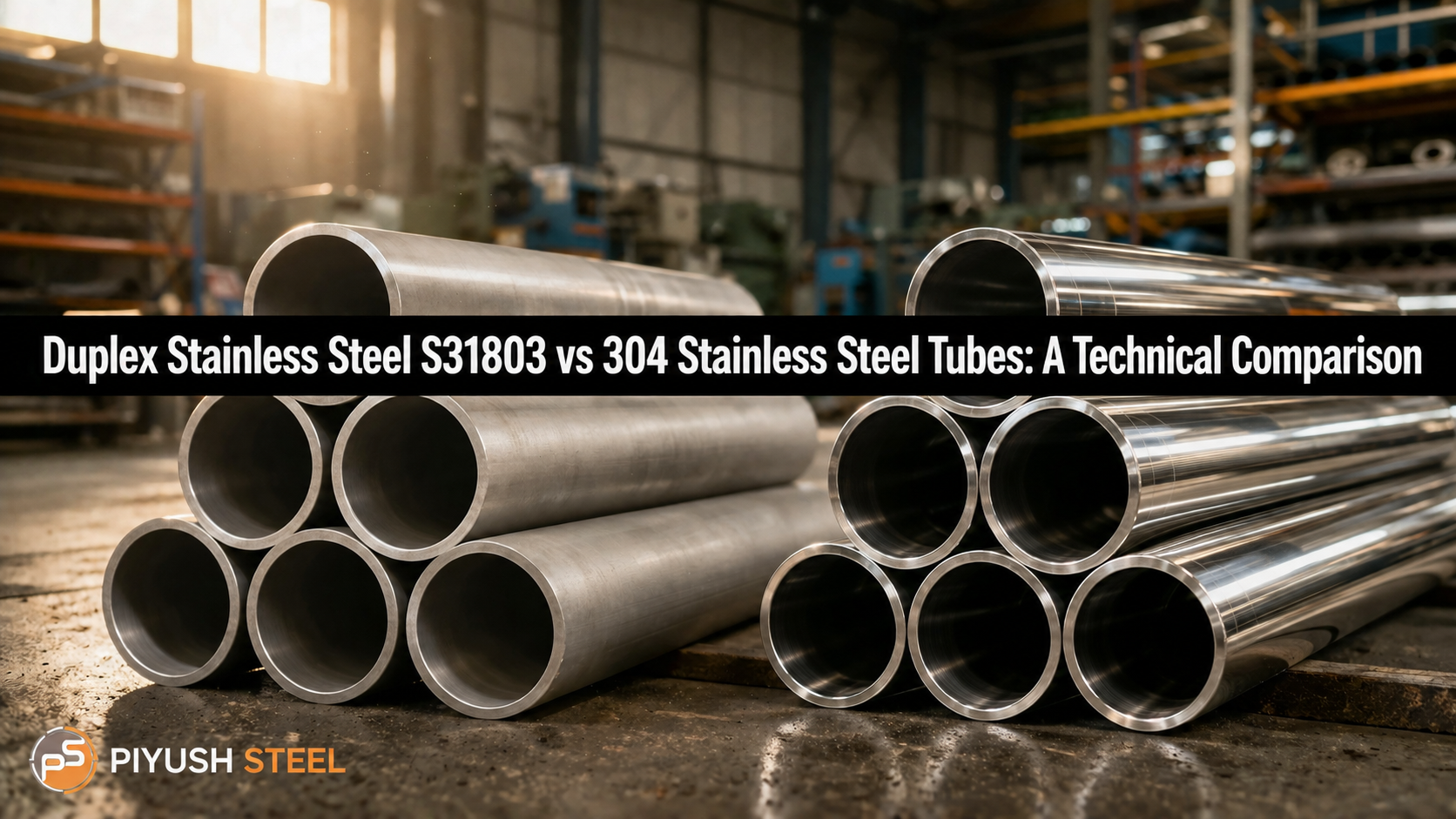
Duplex S31803 and 304 tubes differ vastly, offering a direct choice between high-strength, chloride-resistant performance and standard industrial utility. Duplex Stainless Steel S31803 and SS 304 share the stainless steel label, but their corrosion resistance, mechanical strength, fabrication behavior, and lifecycle cost profiles diverge enough that choosing between them on price alone regularly produces the wrong answer for the application. Duplex Steel S31803 Tubes and 304 tubes comparison gives procurement engineers, design engineers, and plant buyers the technical grounding to match the right tube material to the actual service conditions.
Why Duplex Stainless Steel S31803 and SS 304 Tubes Are Frequently Compared
Demand for both grades continues to grow across chemical processing, oil and gas, food production, and water treatment, which means they appear on the same RFQ lists and sometimes on the same equipment specifications. Both deliver corrosion resistance, both handle pressure, and both weld without requiring exotic procedures. That surface similarity leads buyers into direct comparisons without always examining the conditions that make one outperform the other by a wide margin. Material selection at the tube procurement stage largely determines the service life of the entire system. Getting that choice wrong at procurement means paying for early replacement, extended maintenance shutdowns, or process contamination that certified material documentation won’t reverse.
Duplex Stainless Steel S31803 vs SS 304 Tubes: Comparison at a Glance
| Comparison Parameter | Duplex Stainless Steel S31803 Tubes | SS 304 Tubes |
| Stainless Steel Family | Duplex (austenitic-ferritic), ~50% each phase | Fully austenitic microstructure |
| Corrosion Resistance | Superior resistance to chloride pitting, crevice corrosion, and stress corrosion cracking | Good general corrosion resistance; limited in high-chloride environments above 60°C |
| Mechanical Strength | Min yield ~450 MPa roughly double 304 in the annealed condition | Min yield ~210 MPa; adequate for general-purpose industrial duty |
| Weldability | Weldable with controlled heat input and duplex filler; post-weld phase balance requires attention | Excellent weldability with standard TIG/MIG procedures and ER308L filler |
| Temperature Performance | Effective from −50°C to ~315°C; avoid sustained use above 315°C | Suitable from −196°C to 870°C; loses significant strength above 500°C |
| Pressure Handling | Higher yield allows thinner wall at equivalent pressure rating material saving on large-bore tubing | Handles standard industrial pressures within its yield strength envelope |
| Magnetic Properties | Magnetic due to ferritic phase | Non-magnetic when annealed; may acquire slight magnetism after cold working |
| Typical Applications | Offshore piping, desalination, chemical reactors, heat exchangers, seawater cooling | Food processing, pharmaceutical equipment, architectural tubing, general water distribution |
| Cost Considerations | Higher initial cost; lower replacement frequency in corrosive service reduces 10-year total cost | Lower initial cost; appropriate where extreme corrosion resistance isn’t the governing factor |
| Best Choice When | Chloride-rich environments, high-pressure service, long design life in corrosive media | General fabrication, food contact, moderate environments, cost-sensitive projects |
Material Structure and Its Impact on Performance
Duplex Stainless Steel S31803
S31803 holds a roughly 50/50 split between austenite and ferrite phases. The ferritic phase raises yield strength well above what austenitic grades achieve and gives the alloy its resistance to chloride-induced stress corrosion cracking, the failure mode that terminates 304 tube service in seawater and chloride process streams above 60°C. The austenitic phase contributes toughness and corrosion resistance that pure ferritic grades lack. That combination makes S31803 tubes carry higher loads at thinner walls than 304 requires, which matters in large-bore subsea and chemical plant installations where wall thickness reduction cuts both material weight and total procurement cost at scale.
SS 304 Stainless Steel
304’s fully austenitic structure delivers the toughness, formability, and wide temperature range that make it the default choice for general-purpose industrial applications. No phase transformation occurs between −196°C and 870°C, so 304 tubes handle thermal cycling across that range without microstructural damage. The trade-off: the austenitic structure lacks the ferritic phase that resists chloride attack, and 304 develops stress corrosion cracking in chloride environments above roughly 60°C a threshold commonly exceeded in coastal installations, desalination plant piping, and chemical processes handling hydrochloric acid or chloride-containing brines.
Corrosion Resistance Comparison
304 resists atmospheric corrosion, fresh water, mild acids, and oxidising media well. It fails and fails quickly in concentrated chloride environments, particularly when temperature rises above 60°C. Pitting initiates at surface discontinuities and propagates inward; crevice corrosion accelerates at gasket faces and threaded joints; stress corrosion cracking fractures tubes under tensile stress in chloride-bearing service. S31803 addresses all three failure modes directly. Its Pitting Resistance Equivalent Number (PREN) reaches 34–38 versus 304’s approximately 18 a difference that maps directly onto chloride concentration and temperature limits before pitting initiates. Chemical processing plants handling hydrochloric acid, offshore platforms with seawater cooling circuits, and desalination systems pumping brine at 60–80 bar all specify S31803 because 304 doesn’t sustain passive film integrity at the operating conditions these applications impose.
Strength and Mechanical Performance
S31803 delivers minimum yield strength around 450 MPa. Against 304’s 210 MPa minimum, that gives S31803 tube designers a 2:1 strength advantage allowing wall thickness reductions of 30–40% at equivalent pressure ratings. In 4-inch and larger bore sizes, that wall thickness difference compounds into meaningful material savings on project scale. More directly: a vessel or heat exchanger using S31803 tubes handles higher internal pressure without increasing wall gauge, which expands the design envelope for applications that 304 would require upgrading to heavier schedule to serve.
Weldability and Fabrication Considerations
304 is easy to weld with typical TIG/MIG techniques using ER308L filler. No rigorous heat restrictions. On the other hand Duplex UNS S31803 is requiring strict discipline. Heat input must be strictly controlled in order to avoid excessive ferrite, nitrogen loss and sigma phase production. Successful manufacturing of S31803 requires pre-qualified methods, duplex-matched filler wire and inter-pass temperatures below 250 °C. 304 requires typical stainless steel experience whereas duplex grades required established fabricator competence and tight quality control.
Industry Applications and Material Selection
- Oil and gas S31803 covers subsea flowlines, platform topsides piping, and heat exchanger bundles in produced water and seawater service. 304 rarely appears in offshore applications where chloride concentration makes it unsuitable above ambient temperature.
- Chemical processing acid service above 60°C points toward S31803; mild-acid service at ambient temperature can run 304. Chloride concentration in the process stream is the deciding factor.
- Marine seawater cooling circuits, ballast water systems, and firefighting lines specify S31803 where continuous saltwater contact eliminates 304 within the first 2–3 years of service.
- Heat exchangers S31803 tube bundles handle seawater and brine on the cooling side; 304 suits fresh water and low-chloride cooling applications.
- Power generation condenser tubes in coastal and offshore power plants use S31803 for seawater cooling. Inland plants with low-chloride cooling water can run 304 cost-effectively.
- Food processing 304 dominates here. Stainless Steel 304 Tubes handle CIP cleaning with caustic and acidic detergents at concentrations below 60°C, meet FDA food contact requirements, and cost substantially less than duplex grades for equipment that sees no significant chloride exposure.
Factors to Consider Before Choosing Between Duplex S31803 and SS 304
- Operating Environment: 304 does not work well in high chlorides (> 200 ppm) and high temperatures (> 60°C). S31803 is recommended for corrosive applications.
- Pressure Requirements: The higher yield strength of S31803 allows thinner tube walls to be used, offsetting the raw material cost for high pressure, big bore pipe applications.
- Temperature Limits: S31803 degrades over 315°C due to phase imbalance, 304 softens past 500°C suitable for severe steam usage.
- Fabrication Requirements: 304 can be fabricated using ordinary processes, while extensive field welding of S31803 requires certified welders and unique procedures.
- Lifecycle Cost: The greater initial cost of S31803 compensates for itself in corrosive environments by eliminating excessive maintenance costs, unscheduled shutdowns and replacements.
Common Mistakes to Avoid When Selecting Stainless Steel Tubes
Buying on price alone overlooks the cost of premature replacement. A 304 tube that fails prematurely in chloride service will quickly out cost a durable S31803 tube. Unmonitored chloride levels lead to sudden stress corrosion cracking without warning. Ignoring yield strength leads to pressure deformation. Most important, duplex welding requires unique phase-balance procedures that negate the material savings at the very first maintenance cycle.
Conclusion
Duplex Stainless Steel S31803 tubes and SS 304 tubes each solve specific problems. S31803 handles chloride-rich, high-pressure, long-life applications where 304 develops corrosion failure at operating conditions. 304 covers the broad middle ground of general industrial fabrication, food processing, and moderate-environment service at a lower procurement cost. Match the material to the corrosion exposure, pressure, temperature, and design life the application actually demands that decision determines whether the tube performs through its intended service interval or triggers an early replacement cycle that costs more than any upfront material saving justified.