
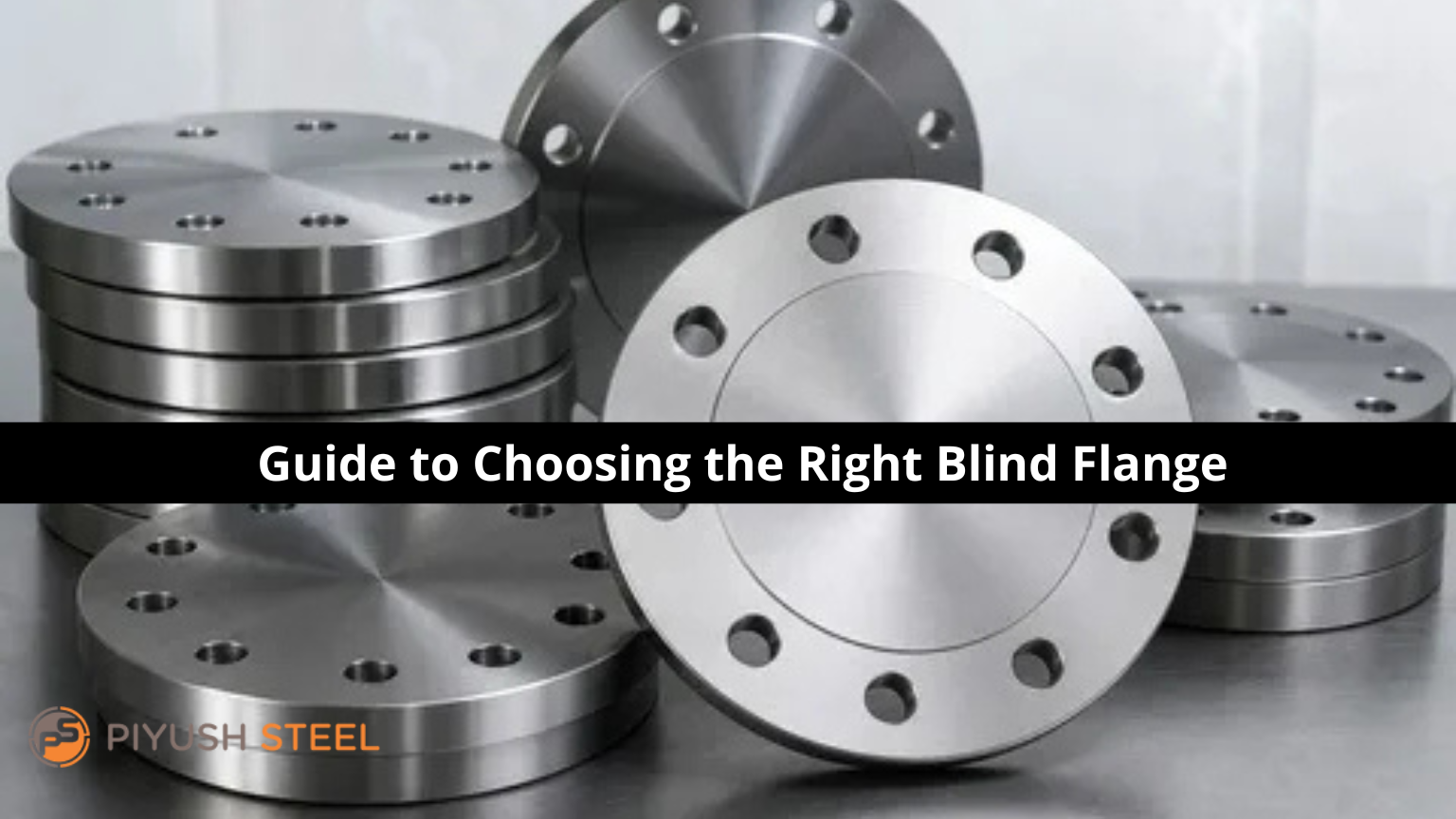
A blind flange placed incorrectly wrong pressure class, incompatible material, mismatched facing fails under exactly the conditions it was installed to withstand. Selecting the right blind flange requires matching material, pressure rating, size, and facing type to the actual operating conditions of the piping system. This guide covers each factor to help engineers and procurement teams make the right call before placing an order.
What is a Blind Flange?
A blind flange is a solid disc used to seal the open end of a pipe, vessel nozzle, or valve. Unlike other flanges, it has no bore; its function is closure rather than connection. That simplicity makes it indispensable for pressure testing isolated sections of a pipeline, blanking off unused nozzles during maintenance, and capping pipe ends that will be extended in future phases of a project.
Blind Flanges manufacturers in India supply these in sizes from ½” NB to 60″ NB across pressure classes from 150# to 2500#, covering the full range of process, utility, and structural piping applications.
Types of Blind Flanges
Blind flanges vary by pressure class (ANSI 150# through 2500#), facing type (raised face, flat face, ring type joint), and material. Each combination suits a different operating environment. Raised face flanges cover most general process applications; ring type joint facings suit high-pressure and high-temperature hydrocarbon service where leak integrity is critical.
Understanding the types of blind flanges available before specifying prevents the most common selection error ordering a standard raised face flange for a service that requires RTJ facing, which only becomes visible when the flange arrives on site.
Factors to Consider When Choosing the Right Blind Flange
Material Selection
Carbon steel (A105, A516 Gr 70) suits general service at moderate temperatures. Stainless Steel Blind Flanges in grades 304L and 316L handle corrosive media, hygienic applications, and cryogenic service. Alloy steel covers elevated-temperature and high-pressure applications in power and petrochemical plant. Duplex and super duplex grades suit chloride-bearing and sour service environments where standard austenitic grades corrode at unacceptable rates. Material selection follows the process fluid, temperature range, and corrosion allowance specified in the piping design basis.
Pressure Class and Temperature Rating
ASME B16.5 pressure-temperature tables define the allowable rating for each material group at every operating temperature. A 316L flange rated at 275 bar at 38°C drops to 138 bar at 450°C selecting the pressure class without checking the temperature rating produces a flange that is underrated for its actual service condition. Always verify the rated pressure at maximum operating temperature, not at ambient.
Flange Size and Pipe Compatibility
Nominal pipe size (NPS) of the blind flange must match the connecting pipe or nozzle exactly. Bolt circle diameter, number of bolt holes, and flange thickness all vary by pressure class a 150# blind flange and a 300# blind flange in the same NPS are not interchangeable despite identical pipe size. Confirm dimensional compliance with ASME B16.5 or B16.47 Series A/B before ordering.
Facing Type and Gasket Compatibility
Raised face flanges pair with spiral wound or ring gaskets; flat face flanges require full-face gaskets to prevent flange face damage under bolt load; RTJ flanges require oval or octagonal ring gaskets machined to the correct groove dimensions. Gasket selection determines sealing performance a mismatched gasket type on an RTJ flange will not seal regardless of bolt torque.
Application Requirements
Cryogenic service requires low-temperature impact-tested material certified to ASTM A350. High-temperature steam service demands alloy steel with controlled carbon and alloying for creep resistance. Chemical injection systems require material resistant to the specific injection fluid, not just the process stream. Specify blind flanges against the full service envelope not just the normal operating condition.
Compliance with Industry Standards
Confirm ASTM material compliance and ASME B16.5 dimensional compliance on every order. Material Test Certificates (EN 10204 3.1) must accompany each shipment, covering chemical composition and mechanical properties by heat number. Projects under PED, ASME Section VIII, or customer-specific quality plans require additional documentation confirmed at order stage.
Supplier Experience and Product Quality
Suppliers with decades of flange manufacturing and export experience carry the inspection infrastructure PMI, hydrostatic testing, dimensional verification, third-party inspection that project quality plans require. Newer entrants may offer lower prices but lack the documentation trail that project engineers and quality auditors demand at handover.
Common Mistakes to Avoid When Selecting Blind Flanges
Specifying 150# flanges on a 300# system because the pipe looks the same is the most frequent error pressure class is not visible from flange appearance. Ignoring material compatibility with the process fluid causes accelerated corrosion that appears within 12 months of commissioning. Using a spiral wound gasket on an RTJ flange produces an instant leak at hydrostatic test. Overlooking ASTM material requirements on certified systems creates documentation hold-points during pre-commissioning inspection. Selecting on price without confirming MTCs and inspection records creates procurement risk that costs more to resolve than the saving justifies.
Conclusion
Blind flange selection requires matching material, pressure class, size, facing type, and standards compliance to actual operating conditions, not to the nearest available stock. Sourcing from experienced blind flange manufacturers in India with documented quality systems ensures the flange performs to specification across its full service life. Contact Piyush Steel to confirm stock availability, material certifications, and lead times for standard and project-specific requirements.