
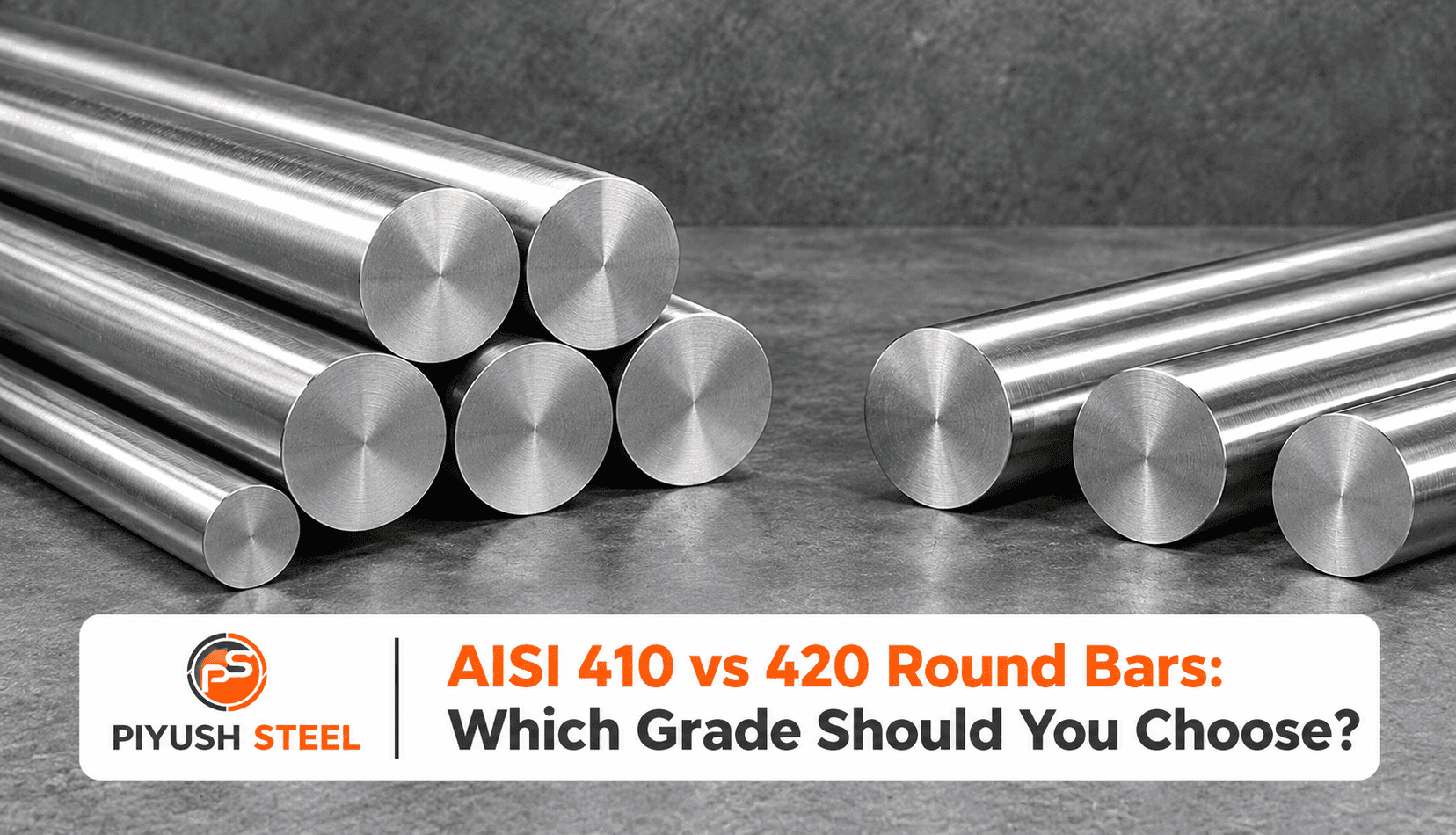
Choose AISI 410 round bars when a component needs balanced strength, toughness and moderate corrosion resistance, and choose 420 round bars when hardness and wear resistance take priority. Both belong to the martensitic stainless steel family and respond to heat treatment, so each delivers strength, hardness and corrosion resistance. Performance diverges with the application. This article compares the two on composition, properties, heat treatment, corrosion resistance, applications and selection requirements.
What Are AISI 410 and 420 Round Bars?
AISI 410 and 420 round bars are cylindrical bars in martensitic stainless steel grades. Both harden through heat treatment, providing strength and hardness, and both serve general industrial components requiring moderate corrosion resistance.
Grade 420 generally offers higher hardness. Grade 410 provides a useful balance of strength, toughness and corrosion resistance. Chemistry explains why: under ASTM A276, 410 caps carbon at 0.15% with 11.5 to 13.5% chromium, while 420 starts at 0.15% carbon paired with 12.0 to 14.0% chromium.
AISI 410 vs 420 Round Bars: Key Differences
| Property | AISI 410 Round Bars | 420 Round Bars |
| Stainless steel type | Martensitic | Martensitic |
| Carbon content | Lower | Higher |
| Hardness potential | High | Higher |
| Strength | Good | High |
| Toughness | Generally better | Comparatively lower at higher hardness |
| Corrosion resistance | Moderate | Moderate |
| Heat treatment | Can be hardened and tempered | Can be hardened and tempered |
| Typical preference | Balanced strength and toughness | Higher hardness and wear resistance |
Carbon content drives most of the gap. Grade 420 carries more carbon, so it hardens further during quenching and holds a cutting edge or a worn surface longer. That extra hardness costs toughness. A 420 bar at its upper hardness range resists impact less well than a 410 bar treated for strength. Grade 410, by retaining more ductility, protects shafts and fasteners from cracking under shock loads. Corrosion resistance occurs because both grades rely on a similar chromium level, and neither replaces austenitic stainless steel in chloride or acidic service.
AISI 410 vs 420: Properties and Performance
AISI 410 Round Bars
- Reaches good strength and hardness after heat treatment, which covers most load-bearing parts
- Combines toughness with corrosion resistance, so components tolerate shock and humid conditions
- Handles moderate wear on sliding surfaces and valve internals, where extreme hardness is unnecessary
- Machines well in suitable material conditions, such as the annealed state, before final hardening
420 Round Bars
- Gains greater hardness from its higher carbon content
- Resists wear on surfaces that rub, scrape, or cut
- Reaches high hardness through heat treatment, followed by tempering to restore some toughness
- Serves cutting and tooling components, where edge retention matters most
AISI 410 vs 420: Applications
| Grade | Common Applications |
| AISI 410 | Shafts, bolts, valves, pumps, fasteners, machine components |
| 420 | Cutlery, surgical instruments, moulds, dies, blades, wear-resistant components |
Grade selection depends on four factors: required hardness, toughness, corrosion environment and operating conditions. A pump shaft needs toughness under cyclic load, so 410 fits. A surgical instrument or die requires a stable surface to maintain its shape and 420 is suitable for this purpose. Parts that interface between the two, such as valve trim, require more attention to hardness goals and media that come into contact. Matching all four factors to the actual component prevents premature wear or sudden fracture.
Which Is Better: AISI 410 or 420 Round Bars?
Neither grade outperforms the other in every case. The requirement decides.
- Choose AISI 410 when the part needs balanced strength, toughness, machinability, and moderate corrosion resistance.
- Choose 420 when hardness, strength, and wear resistance come first.
- Check the heat treatment condition before finalising the grade.
- Match the grade to the operating environment and component requirements.
Quick Selection Guide
| Requirement | Recommended Grade |
| Balanced strength and toughness | AISI 410 |
| Higher hardness | 420 |
| Wear resistance | 420 |
| General engineering components | AISI 410 |
| Cutting / hardened components | 420 |
How to Select the Right Round Bar
Start with the required diameter and length, then confirm the grade, heat treatment condition, required hardness, and the balance of strength and toughness. Review the corrosion environment and machining requirements next. Verify the applicable ASTM or AISI specification and request testing records and mill certificates with each lot. Final selection relies on the actual service conditions of the finished component.
Conclusion
AISI 410 and 420 round bars are considered to be heat-treatable martensitic stainless steels, but each serves a different performance priority. Grade 410 suits applications that need balanced performance. Grade 420 suits parts that require higher hardness and wear resistance. Confirm the heat treatment condition, environment and specification before ordering.