
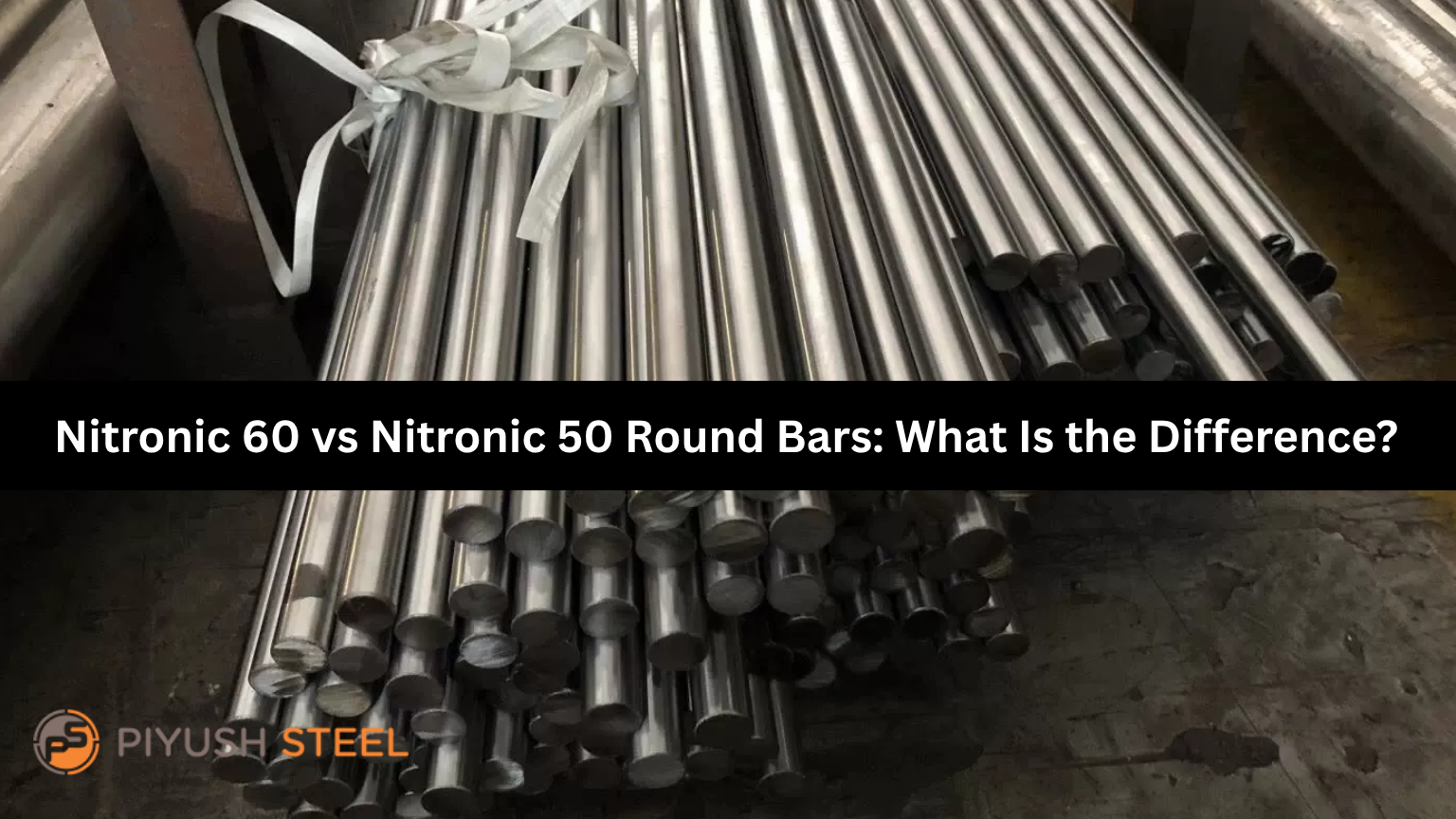
Nitronic 60 and Nitronic 50 round bars are nitrogen-strengthened austenitic stainless steels that are formulated to outperform ordinary 304 and 316 grades. Both alloys, with their chemical makeup including nitrogen, provide the best strength and corrosion resistance for tough industrial conditions. But these different types will be under totally different working loads, so the precise grade choice is critical.
What Are Nitronic 50 and Nitronic 60 Round Bars?
Both grades are manufactured in round bar form for shafts, pins, fasteners, pump components, valve stems, and precision-machined parts where standard stainless grades lack sufficient strength or wear resistance for the intended service.
Nitronic 50 Round Bars
Nitronic 50 Round Bars (UNS S20910) achieve approximately twice the yield strength of 316L stainless in the annealed condition, a direct result of nitrogen’s solid-solution strengthening effect in the austenitic matrix. This premium austenitic alloy provides excellent strength and superior corrosion resistance over 316L, allowing engineers to minimize component weight while maximizing marine hardware durability.
Nitronic 60 Round Bars
Nitronic 60 Round Bars (UNS S21800) address a failure mode that strength and corrosion resistance alone cannot prevent: galling. Nitronic 60 prevents galling, a destructive adhesive wear common in standard stainless steels. It utilizes elevated silicon and manganese to protect metal surfaces under continuous sliding contact, friction, or repeated mechanical movement.
Nitronic 60 vs Nitronic 50: What Are the Key Differences?
| Property | Nitronic 50 Round Bars | Nitronic 60 Round Bars |
| Primary Advantage | High strength and corrosion resistance | Excellent galling and wear resistance |
| Mechanical Strength | High | High |
| Corrosion Resistance | Excellent | Excellent |
| Galling Resistance | Good | Exceptional |
| Wear Resistance | Good | Excellent |
| Friction Performance | Good | Particularly suitable for sliding contact |
| Typical Applications | Marine, chemical, food processing, aerospace | Valves, pumps, bearings, wear components |
| Best Suited For | High-strength corrosive environments | Moving, sliding, and high-wear applications |
Neither grade is universally superior. The correct selection follows from what the application actually demands: strength and corrosion performance, or galling and wear resistance.
How Does Their Chemical Composition Affect Performance?
Nitrogen strengthens both Nitronic 50 and Nitronic 60 by occupying interstitial sites in the austenitic structure and resisting dislocation movement. Chromium provides corrosion resistance, while nickel stabilises the austenitic phase and manganese supports nitrogen solubility. Nitronic 60 also contains approximately 3.5–4.5% silicon, which modifies surface behaviour during sliding contact and reduces adhesive bonding between metal surfaces, improving resistance to galling and wear.
Where Are Nitronic 50 and Nitronic 60 Round Bars Commonly Used?
Nitronic 50 is mainly selected for strength and corrosion resistance, while Nitronic 60 is selected for sliding contact, galling, and wear resistance.
Nitronic 50 Round Bars
- Marine: propeller shafts, deck hardware, and subsea fastenings are subject to seawater and chlorides. All of them are considered sea-related.
- Chemical and food processing: Equipment used in the chemical and food processing industries includes shafts for agitators, pump parts, conveyor shafts and other equipment exposed to corrosive media and mechanical loads.
- Engineering & Structural Components: These are utilised for shafts, pins and other components that require more strength and resistance to corrosion for use in engineering and structural components.
Nitronic 60 Round Bars
- Valves & Pumps: Used for valve stems, wear rings, and shaft sleeves exposed to repeated sliding contact.
- Bearings & Bushings: Used in applications where metal-to-metal contact and limited lubrication can increase the risk.
- Wear Components & Fasteners: Used for sliding wear parts and fasteners requiring repeated assembly and disassembly where galling is a concern.
How Should You Choose Between Nitronic 50 and Nitronic 60?
The selection between the Nitronic 50 and 60 round bars is a trade-off between the mechanical load requirements, operational wear and environmental corrosion. Piyush Steel assures you of genuine mill-verified stock as per your application requirements.
- Use Nitronic 50 where high yield strength and maximum corrosion resistance are important in marine or chloride conditions.
- Choose Nitronic 60 for components that will encounter sliding metal-to-metal contact, moving threads and/or high galling and wear potential.
- Evaluate operating temperatures to verify that stress limits are within acceptable limits as per applicable codes for mechanical design.
- Please check bar diameters, machining tolerances and stock availability with Piyush Steel before finalising parameters.
Conclusion
Nitronic 50 Round Bars deliver the combination of elevated yield strength and superior corrosion resistance that demanding structural and marine applications require. Nitronic 60 Round Bars solve the galling and sliding wear problems that eliminate standard stainless from moving-contact applications. The correct grade follows from the component’s dominant operating requirement, not from which grade appears more capable on paper.