
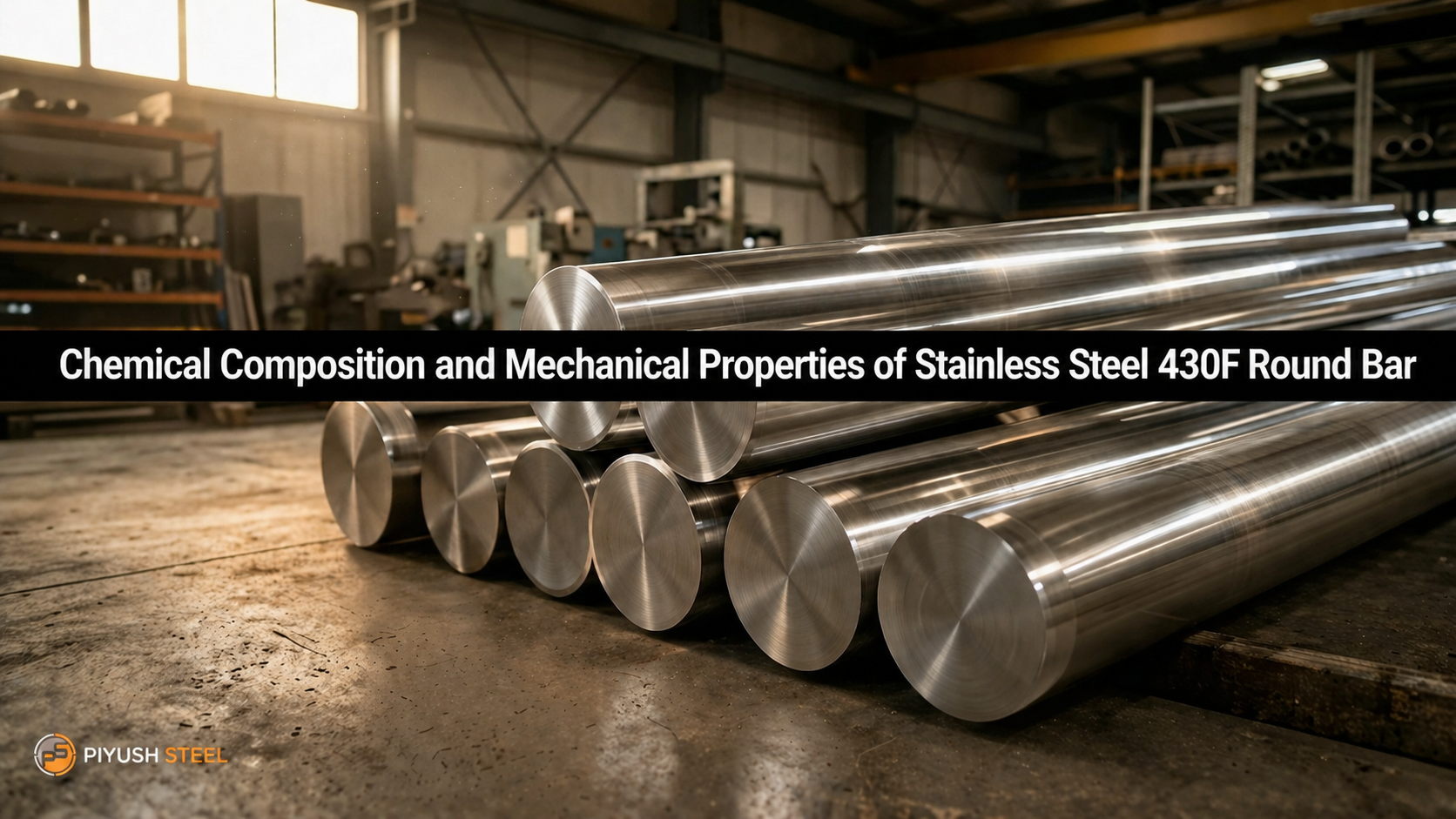
Stainless Steel 430F Round Bar is a free-machining ferritic stainless steel grade designed for efficient production of precision-engineered components. However, selecting the right material requires more than reviewing a specification sheet. Understanding the chemical composition and mechanical properties of Stainless Steel 430F Round Bar provides valuable insight into its machinability, strength, hardness, and corrosion resistance. These characteristics help determine whether the material is suitable for a specific application, enabling buyers and engineers to make informed decisions based on performance requirements rather than relying solely on the grade designation.
Why Chemical Composition and Mechanical Properties Matter
Engineers review composition and mechanical data before selecting a material because those two factors determine everything the part does afterward how it machines, how it holds a load, and how long it lasts in the intended environment. Composition sets the baseline: corrosion resistance, hardness potential, and machinability all trace back to which elements the alloy contains and in what proportion. Mechanical properties translate that chemistry into numbers a designer can actually calculate against yield strength for load capacity, hardness for wear resistance. Skipping this step and buying on price or availability alone is how a part fails a service condition the material was never suited for in the first place.
Understanding the Chemical Composition of Stainless Steel 430F Round Bar
Chromium
Chromium sits at 16–18% in SS 430F, forming the passive oxide layer that gives every stainless steel its corrosion resistance. At this level, the alloy resists oxidation and general atmospheric corrosion reasonably well, though not to the standard of austenitic grades like 304 or 316.
Sulfur
Sulfur is where 430F earns its “free-machining” designation. Standard SS 430 caps sulfur near 0.03%; 430F deliberately raises it to a minimum around 0.15%. That addition breaks up the chip during machining, cutting tool wear and improving surface finish on turned parts at a direct cost to corrosion resistance and weldability, which is why the two grades exist as separate products rather than one.
Carbon, Silicon, and Manganese
Carbon stays capped near 0.12% maximum, keeping the alloy soft enough for consistent machining without excessive hardness variation. Silicon and manganese, each held under roughly 1.0–1.25%, support deoxidation during melting and contribute modestly to strength without pushing the alloy toward brittleness. None of these three elements defines 430F the way chromium and sulfur do they round out the composition rather than driving its core behavior.
How Chemical Composition Influences Material Performance
The sulfur addition drives most of what makes 430F distinct in practice. Machinability improves substantially over standard 430, letting shops run higher speeds and feeds with better tool life and cleaner surface finish straight off the lathe. Corrosion resistance moves the opposite direction the sulfide inclusions that improve chip formation also create sites where pitting and crevice corrosion can start, particularly in chloride-containing environments.
Wear resistance stays moderate, adequate for general machined components but not suited to abrasive service. As a ferritic stainless steel, 430F stays magnetic across its full temperature range, unlike austenitic grades a detail that matters for any application near magnetic sensors or clamping fixtures.
Understanding the Mechanical Properties of SS 430F Round Bar
Tensile and yield strength indicate how much load a finished part carries before deforming or failing in the annealed condition, SS 430F typically runs tensile strength in the 415–600 MPa range with yield strength around 275 MPa minimum. Elongation, generally 20% minimum, shows how much the material stretches before fracture, a useful indicator of how it behaves under sudden or shock loading rather than steady service loads. Hardness, often quoted near 262 HB maximum in the annealed condition, tracks closely with wear resistance and machinability softer material machines faster but wears sooner under abrasive contact. None of these numbers means much in isolation; together, they describe how the bar behaves from the first machining pass through years of service.
Why These Properties Matter in Real-World Applications
Precision-machined components benefit directly from the combination 430F offers decent strength paired with machinability that keeps cycle times down on high-volume runs. Shafts and pump components draw on that same balance, particularly where dry or mildly corrosive conditions don’t demand austenitic-grade resistance. Valve parts and fasteners round out the typical application list, where moderate strength and a magnetic response occasionally serve as a functional requirement rather than just a material characteristic.
Factors to Evaluate Before Selecting SS 430F Round Bar
- Machining requirements: batch size, tolerance, and surface finish targets
- Corrosion exposure: atmospheric, chloride-containing, or controlled dry environments
- Strength requirements: against the actual service load, not just a general safety margin
- Service environment: temperature range and any contact with sensitive coatings
- Dimensional requirements and available round bar sizes from stock
- Applicable industry standards, such as ASTM A276 or ASTM A582
Common Misconceptions About Chemical Composition and Mechanical Properties
Higher hardness doesn’t automatically mean a better material it often trades away toughness and machinability that the application actually needs. Better machinability doesn’t translate into better corrosion resistance either; in 430F’s case, the two move in opposite directions entirely. Material selection has to weigh composition and service conditions together, since no single property on a data sheet tells the full story of how a part performs once it’s installed.
Conclusion
Chemical composition and mechanical properties of Stainless Steel 430F Round Bar work as a set, not as isolated numbers on a certificate. Chromium and sulfur content shape machinability and corrosion behavior in opposite directions, while tensile strength, yield strength, and hardness translate that chemistry into how the part performs under load. Buyers who evaluate both sides together rather than reading a specification table in isolation end up selecting material suited to the actual machining and service requirements in front of them.