
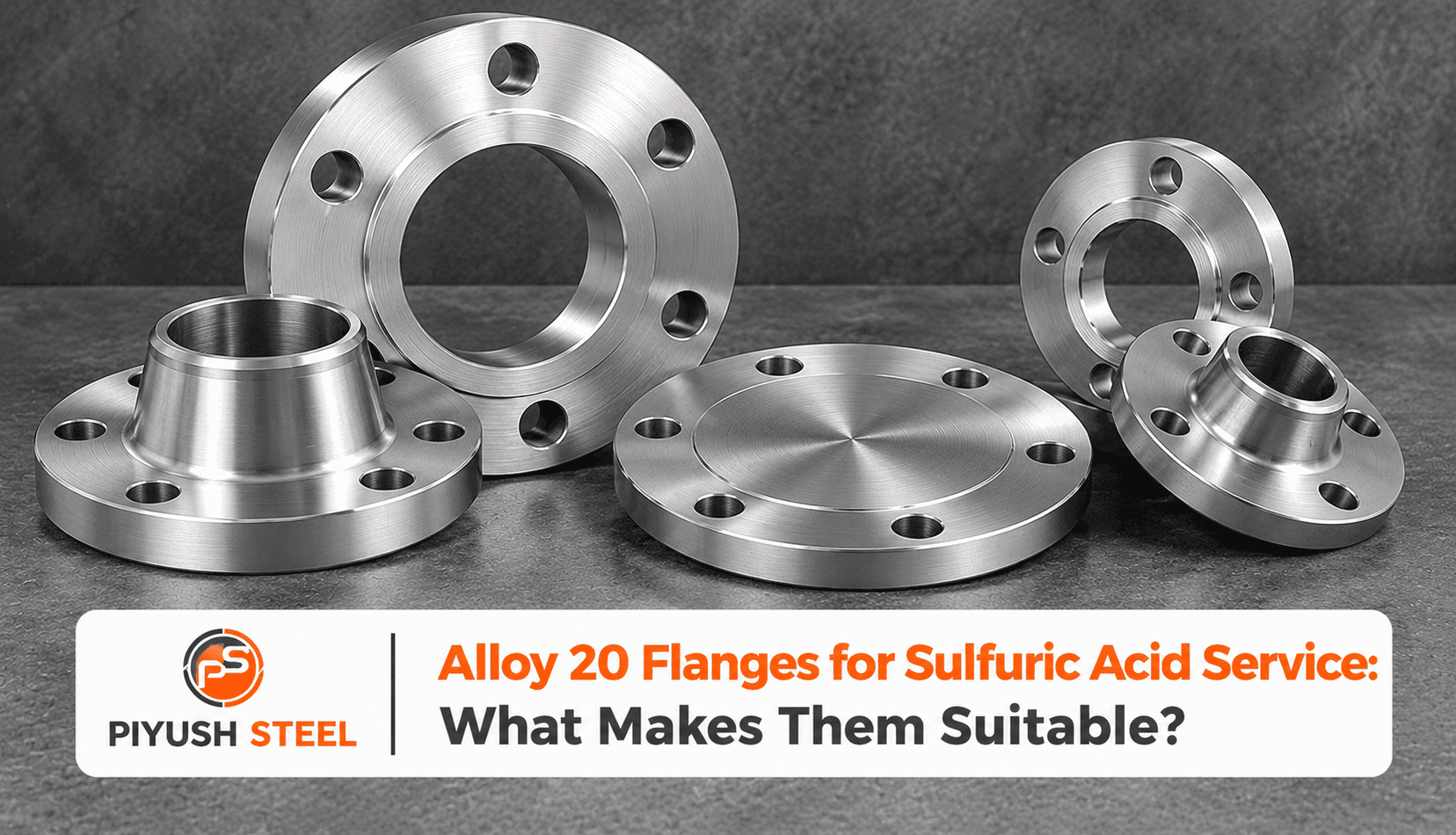
Alloy 20 Flanges suit sulfuric acid service because the alloy resists acid damage across a practical range of concentrations and temperatures. These corrosion-resistant flanges serve demanding chemical processing environments. Sulfuric acid at 20% acts differently from acid at 98%, and heat or impurities shift results further. Corrosion resistance, operating concentration, temperature, pressure and flange compatibility determine how long a flanged connection lasts.
What Are Alloy 20 Flanges?
Alloy 20 Flanges are forged pipe connections made from a nickel, iron and chromium alloy with added copper and molybdenum. Their corrosion resistance suits sulfuric acid and other aggressive process media, which makes them a common choice for joining pipes, valves and vessels in chemical plants.
Flanged connections join piping sections, pumps, heat exchangers and tanks, and they let crews open a line for inspection. In sulfuric acid service, each joint must hold pressure and resist corrosion together, so flange material matters as much as the pipe.
Why Are Alloy 20 Flanges Suitable for Sulfuric Acid Service?
Six material characteristics support the alloy’s use in acid piping.
- Sulfuric Acid Corrosion Resistance: Copper and molybdenum additions let the alloy resist sulfuric acid across a range of concentrations at moderate temperatures. Corrosion rates climb with heat and impurities, so published corrosion data sets the service limit.
- Resistance to Localized Corrosion: Molybdenum improves resistance to pitting and crevice attack, which matters at gasket faces where acid can pool.
- Stress Corrosion Cracking Resistance: The high nickel content gives excellent resistance to chloride stress corrosion cracking in contaminated process streams.
- Chemical Processing Performance: The alloy handles sulfuric, phosphoric and some other acid streams, so one flange material can serve more than one line.
- Durability: Low corrosion rates slow wall loss at the flange face and bore, which extends service intervals.
- Flange Integrity: A flange that pits or thins loses sealing force, so corrosion resistant material protects the joint holding the piping together.
Actual performance still depends on concentration, temperature, impurities and operating conditions.
Alloy 20 Flanges: Key Properties for Sulfuric Acid Applications
Each property below ties directly to flange behavior.
| Property | Importance in Sulfuric Acid Service |
| Corrosion resistance | Slows metal loss on the gasket face and bore when sulfuric acid contacts the joint. |
| Pitting resistance | Limits small localized pits that can disturb gasket seating. |
| SCC resistance | Protects stressed flange sections, such as the hub and bolted areas, in chloride bearing streams. |
| Mechanical strength | Carries bolt loads and line pressure, so the flange keeps its seal at the rated class. |
| Fabricability | Allows forging, machining and welding, and the niobium stabilized grade keeps weld zones corrosion resistant. |
| Chemical stability | Holds a stable surface in process equipment, so flange faces stay consistent between inspections. |
Where Are Alloy 20 Flanges Used?
Engineers select flanges in this alloy where sulfuric acid or similar media corrode carbon steel and standard stainless grades such as 316. Sulfuric acid processing units use them on transfer lines, heat exchanger connections and reactor nozzles. Chemical processing plants fit them to lines that carry mixed corrosive media. Fertilizer manufacturers specify them for sulfuric and phosphoric acid handling. Petrochemical units apply them in acid alkylation and acid wash circuits. Pharmaceutical and food process equipment uses them in acid cleaning loops, where corrosion products could contaminate the product. Storage and transfer systems add them at tank nozzles and pump connections, where acid contact is continuous.
How to Select Alloy 20 Flanges for Sulfuric Acid Service
Evaluate corrosion performance against the actual sulfuric acid concentration, temperature and process conditions, not against a general alloy rating. Confirm the remaining factors below before issuing a purchase specification.
| Selection Factor | What to Check |
| Acid concentration | Actual sulfuric acid concentration |
| Temperature | Operating and design temperature |
| Pressure | Required pressure rating, such as Class 150 or 300 |
| Flange size | NPS and dimensional requirements |
| Facing | Required flange facing |
| Standard | Applicable dimensional and material standard, such as ASTM B462 and ASME B16.5 |
| Gasket compatibility | Compatibility with the process medium |
| Testing | Inspection and certification requirements, including EN 10204 3.1 material test certificates |
Alloy 20 Flanges vs Other Materials for Sulfuric Acid Service
Corrosion resistance alone does not settle material selection. Cost, availability, pressure class and fabrication all enter the decision, and a different alloy may suit conditions beyond Alloy 20’s limits. The table below compares the main points.
| Consideration | Alloy 20 Flanges |
| Sulfuric acid resistance | Strong under suitable conditions |
| Mechanical performance | Suitable for demanding piping connections |
| Chemical processing use | Common consideration |
| Selection priority | Concentration, temperature and pressure |
Conclusion
Alloy 20 Flanges earn consideration for sulfuric acid service because their corrosion resistance and mechanical strength suit demanding chemical processing environments. The correct specification still depends on acid concentration, temperature, pressure, dimensions, applicable standards and actual service conditions. Confirm each of these with published corrosion data and supplier documentation before ordering.