
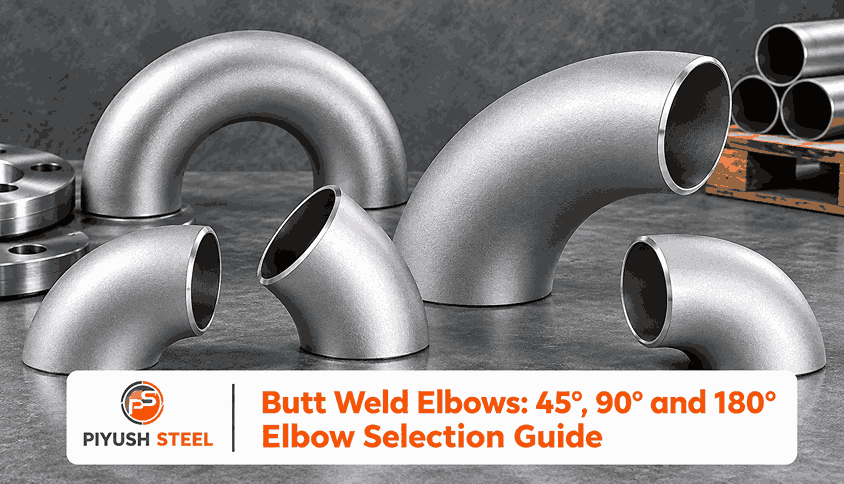
Piping systems change direction constantly, and butt-welded elbows carry the load at every turn, tie-in, and equipment connection across a plant. These fittings join to a straight pipe through a full-penetration weld, forming a continuous metallic path with no threads or seals to fail. Three angle configurations cover most layouts: 45°, 90°, and 180°. This guide covers elbow types, radius options, materials, standards, manufacturing, and the factors that decide which fitting suits a given piping run.
What Is a Butt Weld Elbow?
A butt weld elbow is a curved pipe fitting that changes pipeline direction by joining to adjacent pipe ends through a full-penetration weld. The pipe and fitting walls fuse during welding, so the joint carries the same pressure rating as the parent pipe. Threaded and socket weld connections rely on mechanical engagement or a fillet weld around a socket cavity, both of which leave a stress point that a butt weld avoids. This makes the fitting a common choice for high-pressure piping in refineries, chemical plants, and offshore platforms.
How Butt Weld Elbows Work in Piping Systems
An elbow redirects fluid by curving the flow path instead of forcing it through a sharp corner. Welded to straight pipe on both ends, it becomes part of a continuous run alongside tees, reducers and other butt weld fittings. Alignment matters before welding starts; a misaligned joint creates turbulence and uneven wall stress once pressurised. The bend radius and angle also influence pressure loss: a tighter bend increases resistance to flow, while a longer radius smooths the transition.
Advantages of Butt Weld Elbows
A properly welded elbow forms a permanent, monolithic joint that will not loosen under vibration or thermal cycling the way a threaded connection can. This strength supports high-pressure piping across the oil and gas, power, and process industries. The weld eliminates the crevice found in threaded or socket joints, removing one of the most common leak paths in mechanically joined piping. The internal bore stays smooth and matches the pipe’s inside diameter, so fluid moves through the bend with lower turbulence and less pressure drop. A compact profile also keeps the overall footprint small, which matters in congested plant layouts.
Types of Butt Weld Elbows by Angle
Three elbow angles cover most piping layouts: 45°, 90°, and 180°, each suited to a different directional change.
45° Butt Weld Elbow
A 45° elbow shifts pipe direction gradually, keeping flow more streamlined. It suits offset runs around existing structures or gradual elevation changes where a full right angle does not fit the layout.
90° Butt Weld Elbow
The 90° elbow is the most widely used angle in industrial piping, since most plant layouts need a right-angle change somewhere in the run. It appears at wall penetrations, equipment connections, and tight direction changes.
180° Butt Weld Elbow
A 180° elbow, or return bend, reverses flow direction entirely within a compact space. It suits heat exchanger piping and return lines where the pipe run doubles back rather than continuing forward.
| Elbow Angle | Primary Function | Typical Use |
| 45° | Gradual direction change | Flow redirection |
| 90° | Right-angle direction change | General piping layouts |
| 180° | Complete flow reversal | Return piping systems |
Butt Weld Elbows by Radius
Radius classification splits elbows into two groups: long radius, at 1.5 times the pipe diameter, and short radius, at 1 time the diameter. A long-radius bend spreads the direction change over a larger arc, lowering turbulence and pressure drop across the fitting. Short-radius elbows fit tighter spaces but generate more resistance to flow under the same conditions. Most piping specifications default to long-radius fittings, reserving short-radius elbows for layouts where clearance genuinely will not allow anything larger.
Butt Weld Elbows by Material
Choosing the right alloy follows the same logic used for the connecting pipe: match it to pressure, temperature, and the fluid it will carry. Carbon steel covers general water, air, and hydrocarbon service at moderate temperatures and cost. Stainless steel handles corrosive media and higher-purity applications where iron contamination is unacceptable. Alloy steel grades add chromium and molybdenum for elevated-temperature strength in power and refining service. Duplex and nickel-based alloys step in where chloride stress corrosion cracking or extreme temperatures rule out standard grades. The connecting pipe specification usually dictates the elbow material.
Butt Weld Elbow Standards
ASME B16.9 sets the dimensional standard for factory-made wrought butt-welding fittings, including elbows, and most piping specifications reference it directly. The standard fixes centre-to-end dimensions, wall thickness tolerances, and layout tables that allow a butt-welded elbow from one supplier to be interchanged with another without redrawing the isometric. Material standards vary: ASTM A234 covers carbon and alloy steel fittings, while ASTM A403 covers stainless grades. Checking the purchase order and piping class against the applicable code before ordering helps avoid mismatched fittings on site.
Butt Weld Elbow Manufacturing Process
Manufacturing starts with cutting pipe or plate to the required blank size, followed by hot forming or induction bending to the specified angle and radius. Fabricators trim the formed piece to length and bevel the ends to match the connecting pipe’s weld preparation. Heat treatment follows where the specification requires stress relief or normalising, especially for higher-carbon and alloy grades. Final steps include machining the bevel, cleaning the surface, and checking dimensions before the fitting moves to inspection.
Butt Weld Elbow Quality & Testing
Before a butt-welded pipe elbow enters service under pressure, quality inspection confirms it meets the dimensions, material properties, and defect limits the project demands. Dimensional checks verify centre-to-end length, wall thickness and bevel angle against the standard. Visual examination catches surface defects such as cracks or seam irregularities, while radiography or ultrasonic testing screens for internal flaws that visual inspection cannot detect. Material test certificates and heat numbers provide traceability back to the original cast, often required for full documentation.
Applications of Butt Weld Elbows
Butt-weld elbows appear across nearly every sector that moves fluids or gases through pressure piping, from upstream extraction to downstream processing.
Oil & Gas Piping
Process piping on production platforms and pipelines relies on these elbows to route hydrocarbons around vessels and compressors under pipeline-grade pressure.
Chemical & Petrochemical Plants
Process units route corrosive, high-temperature streams through congested pipe racks, where elbows change direction between reactors, columns and heat exchangers.
Power Generation
Steam and boiler feedwater piping in power plants uses elbows rated for high-pressure and high-temperature service, suited to thermal cycling.
Refineries
Complex piping networks connecting distillation and cracking units depend on elbows to navigate tight pipe racks without adding unnecessary straight-run length.
Water & Process Industries
Water treatment and process facilities use elbows in carbon or stainless steel, depending on whether the fluid is potable water or a treated process stream.
How to Select the Right Butt Weld Elbow
Selecting the correct elbow starts with the piping isometric: the required angle, 45°, 90°, or 180°, comes directly from the drawing, leaving the radius as the main open decision. Long radius suits most general service; short radius earns its place only where clearance rules out anything larger. Material has to match the connected pipe and fluid, accounting for corrosion, erosion, and thermal cycling. Size and wall thickness must align with the pipe on both ends, and the pressure-temperature rating needs to cover the worst operating condition, not just the average. Confirming the applicable ASME or ASTM standard against the purchase order prevents a mismatched fitting from reaching the site.
| Selection Factor | What to Check |
| Angle | 45°, 90°, or 180° |
| Radius | Long or short radius |
| Material | Match pipe and service environment |
| Size | Pipe diameter and wall thickness |
| Pressure | Operating and design pressure |
| Temperature | Operating temperature range |
| Standards | Applicable ASME/ASTM requirements |
Conclusion
These fittings give a piping system permanent, full-strength direction changes that threaded or socket connections cannot match at the same pressure rating. The 45°, 90° and 180° angles each solve a different layout problem, and getting the radius, material, size and standard right determines how the fitting performs once the line is in service. Piyush Steel manufactures elbows in stainless steel, nickel alloy, carbon steel, and API X65 grades to ASME B16.9 dimensions. Contact our team to confirm sizes, schedules, and material availability for your project.