
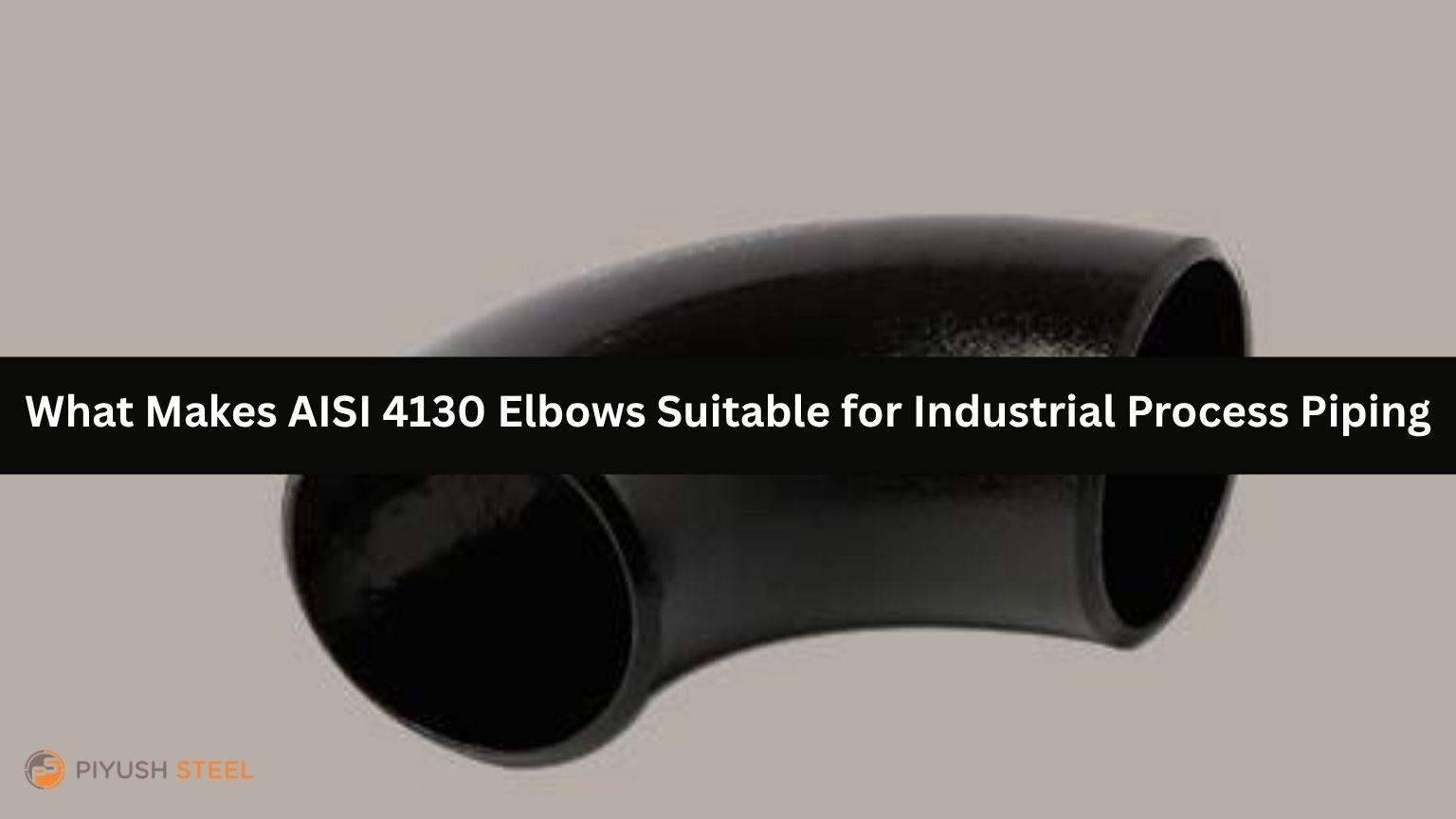
Piping systems rarely run in straight lines. Every direction change, every branch, every tie-in to a vessel or pump depends on a fitting strong enough to hold the line together under stress. Elbows carry that load at the exact point where flow direction shifts and pressure concentrates. Get the material wrong, and that single fitting becomes the weakest link in an otherwise engineered system.
Material selection decides how a piping network performs over its working life. A fitting that cracks under thermal cycling or deforms under pressure spikes forces shutdowns, replacements, and unplanned costs. This is where the AISI 4130 Elbow earns its place. Refineries, oil and gas plants, power stations, and chemical processing units specify this fitting where mechanical strength and pressure tolerance cannot be compromised.
What Is an AISI 4130 Elbow?
An AISI 4130 Pipe Elbow is a chromium-molybdenum alloy steel fitting that is used to change the flow direction in a piping run. Chromium content adds hardness and corrosion resistance. Molybdenum adds strength that holds up at elevated temperatures. Fabricators produce these fittings as 45°, 90°, and 180° bends to match whatever geometry a pipe route demands. Both seamless and welded construction are available, giving engineers flexibility to match the fitting type to the pressure class and application at hand. Many process plants source Industrial AISI 4130 Elbows specifically for lines that combine high pressure with mechanical vibration.
Why Is AISI 4130 Suitable for Industrial Process Piping?
High Mechanical Strength
An AISI 4130 Alloy Steel Elbow handles heavy operating loads without yielding at the bend. It is ideal for demanding environments where pressure and mechanical stress are combined. The alloy composition is good for long life under repeated load cycles.
Excellent Pressure Resistance
A 4130 steel High Pressure Pipe Elbow can be trusted to withstand a high internal pressure without ballooning or thinning at the curve. This stability is vital to the operation of the critical process fluid pipelines. Less deformation risk maintains flow geometry over years of service.
Performs Well at Elevated Temperatures
Chrome Moly Pipe Elbow fittings retain stable mechanical properties as operating temperatures climb. Boilers rely on this stability during startup and shutdown cycles. Heat exchangers, power plants, and refineries all route high-temperature process streams through this same alloy family for the same reason: strength that doesn’t fall off as heat rises.
Good Weldability
A 4130 Buttweld Elbow fabricates easily into existing pipe runs. It’s compatible with standard industrial welding methods, including TIG and MIG processes used across fabrication shops. The resulting welded joints hold strength close to the parent metal, which matters when a joint sits at a stress concentration point like a bend.
Reliable Fatigue Resistance
Piping systems flex, vibrate, and cycle through pressure changes daily. An ASTM A519 4130 Elbow absorbs that vibration without developing fatigue cracks at the bend radius. Dynamic piping systems near rotating equipment, such as compressors and pumps, benefit most from this resistance to repeated stress cycling.
Key Advantages of Using AISI 4130 Elbows
- High strength-to-weight ratio: It delivers load-bearing capacity without adding excess mass to the pipe run
- Long operational life: They resist the wear mechanisms that shorten service life in lower-grade fittings
- Reliable performance: Helps to maintain dimensional stability across pressure and temperature swings
- Reduced maintenance: Fewer inspection flags and replacements over the operating cycle
- Good machinability: It allows precise fabrication for custom bend angles and end preparations
- Better resistance to wear: Holds up against erosive flow and abrasive process media
- Cost-effective over long service periods: It has a lower total cost of ownership despite a higher upfront material grade
Factors to Consider Before Selecting an AISI 4130 Elbow
Choosing the right fitting starts with pipe size and schedule, since wall thickness directly affects how much pressure the elbow can carry. Then the temperature range and pressure rating. These two factors determine whether a normal Seamless AISI 4130 Elbow will be adequate or if a higher schedule is needed. Elbow angle depends on the routing layout. Most systems use 90° bends, though 45° and 180° options solve tighter routing constraints. Seamless versus welded construction is another decision point. Seamless fittings are used for critical service lines that have higher pressure. Welded fittings are used for less demanding runs and are less expensive. The metallurgy itself is as important as meeting the recognized standards. ASTM A519 4130 Elbow fittings provide the documented traceability that plant engineers and inspectors require. Installation requirements such as end preparation and flange compatibility are also included in the list before procurement.
Conclusion
Alloy Steel Pipe Fittings built from AISI 4130 combine mechanical strength, pressure resistance, and fatigue performance in one fitting, making them a practical choice for process piping that runs hot, moves fast, and never stops working. From Industrial Pipe Elbows in refinery units to power plant steam line butt welds, this alloy holds up where standard carbon steel fails. Piyush Steel offers AISI 4130 elbows, seamless and welded, in all standard bend angles and pressure classes. Request a quote and technical datasheet to know the pipe size and pressure requirements.