
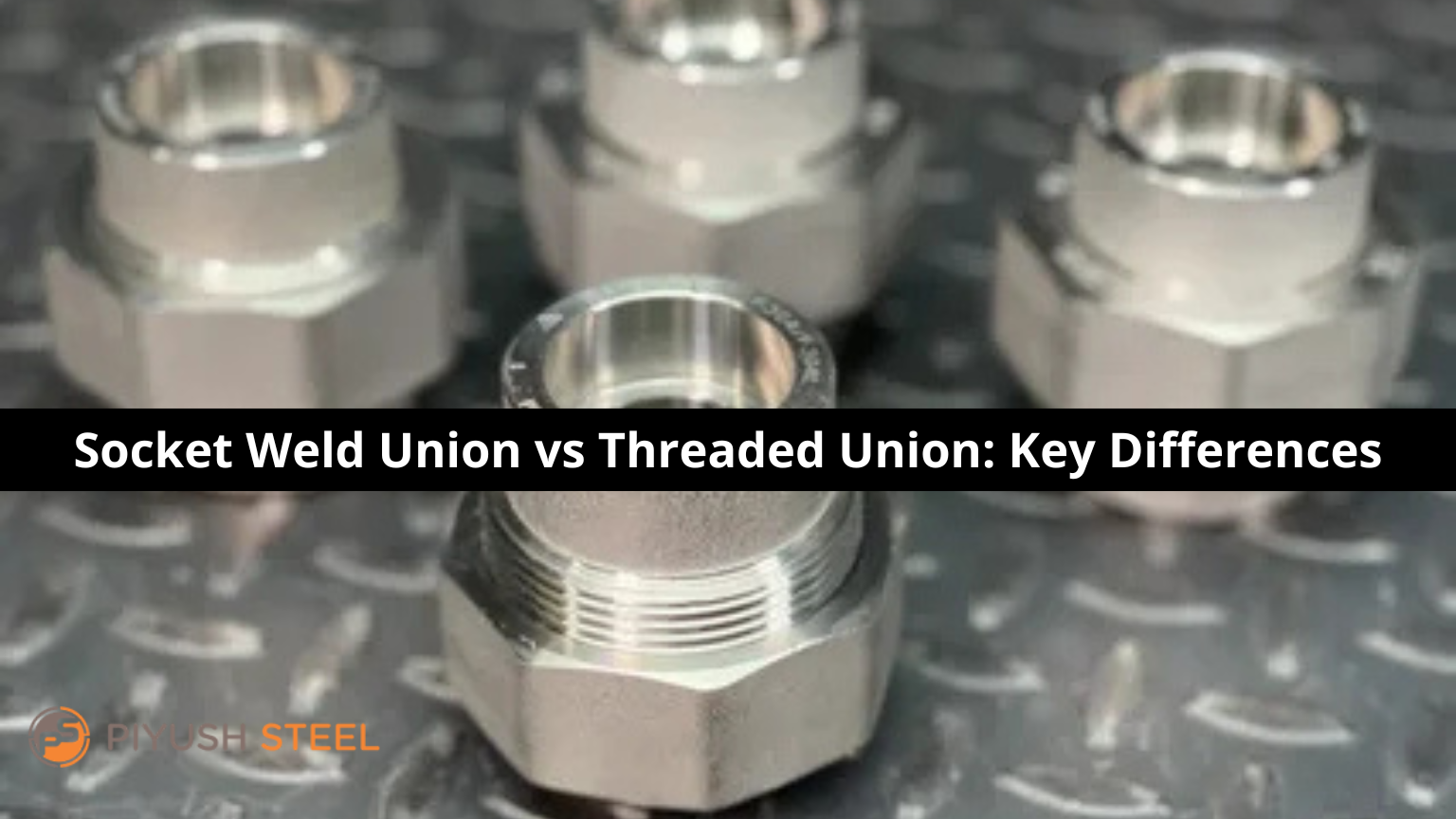
Socket weld and threaded unions both disconnect piping systems cleanly but they handle pressure, temperature, and maintenance conditions differently enough that using the wrong type creates problems that show up in service rather than at installation. This guide compares both union types across the factors that matter for industrial piping selection.
Understanding Socket Weld and Threaded Unions
Socket weld unions insert the pipe end into a socket in the fitting body, then fillet-weld the joint at the outer face. The weld creates a permanent, high-integrity connection between pipe and fitting the union nut allows the assembly to be broken and remade at the union face rather than at the pipe joint itself.
Threaded unions connect by screwing male NPT or BSPT threads on the pipe or fitting directly into the union body. No welding is involved the joint relies on thread engagement and, for liquid service, thread sealant or PTFE tape to achieve leak-tightness. Assembly and disassembly require only spanners, with no heat source or welding qualification needed on site.
Key Differences Between Socket Weld and Threaded Unions
Joint Design and Installation
Socket weld unions require a qualified welder and welding procedure installation takes longer and demands more skilled labour than threaded connections. Threaded unions assemble with standard hand tools in minutes. The trade-off is permanence: the welded joint is stronger and more reliable in service; the threaded joint is faster to make and easier to change.
Pressure & Temperature Capability
Socket weld unions to ASME B16.11 Class 3000 handle pressures above 200 bar at moderate temperatures the fillet weld carries mechanical load as well as sealing. Threaded unions in the same class are rated to equivalent nominal pressure, but thread integrity degrades under thermal cycling, vibration, and repeated make-and-break more quickly than welded connections. Above 230°C or in high-vibration service, socket weld is the safer specification.
Ease of Maintenance
Threaded unions win here outright. Breaking and remaking a threaded union takes minutes without any hot work permit, heat source, or post-work inspection. Socket weld unions require cutting the weld bead to disassemble and re-welding to reconnect adding hours and hot work compliance overhead to each maintenance cycle. In systems requiring frequent instrument removal or filter replacement, threaded unions reduce maintenance downtime significantly.
Sealing Reliability
Welded socket connections do not rely on thread engagement or sealant the fillet weld seals against pressure from day one and maintains that seal indefinitely under pressure cycling and vibration. Threaded unions depend on thread condition and sealant integrity; vibration and thermal cycling loosen threads progressively in demanding service, increasing leak frequency over time.
Space and Installation Flexibility
Both union types suit confined spaces. Threaded unions have a slight advantage in extremely restricted locations where positioning a welding torch is physically difficult. Socket weld unions require clear access around the joint circumference for the welder a constraint that occasionally drives threaded union selection even in higher-pressure systems.
Cost and Long-Term Value
Threaded unions cost less to install initially no welding labour, no weld inspection, no hot work permit. Socket weld unions carry a higher installation cost but lower lifetime maintenance cost in demanding service. In high-pressure, high-temperature, or high-vibration applications, the reliability advantage of welded connections reduces leak-related maintenance costs that threaded unions accumulate over years of service.
Side-by-Side Comparison Table
| Parameter | Socket Weld Union | Threaded Union |
| Connection Method | Fillet weld | NPT/BSPT thread + sealant |
| Pressure Capability | High Class 3000/6000 | Moderate Class 2000/3000 |
| Temperature Suitability | Up to 425°C+ | Below 230°C recommended |
| Maintenance | Cut and re-weld | Spanner disassembly |
| Leak Resistance | Excellent welded seal | Good depends on thread condition |
| Installation Time | Longer | Faster |
| Best Applications | High-pressure, high-temp process | Instrument connections, low-pressure utility |
Which Union is Best for Different Industries?
The choice of the appropriate pipe union depends on the operating pressure, temperature and fluid chemistry. A proper mix of union types with defined service demands makes it possible to avoid expensive joint leaks and allows speedy maintenance.
- Oil & Gas Processing: Forged steel hammer unions or Class 3000 socket weld unions for high pressure withstand tremendous vibration.
- Chemical Plants: Severe process pitting and extensive acid corrosion are resisted by stainless steel (316L) unions.
- Steam and Boiler Systems: Forged alloy steel unions have resistance to extended heat cycling and high-pressure steam loads.
- Water Distribution: Potable pipes use rust-shielded unions of galvanized malleable iron or brass threaded unions.
- Fire Protection Systems: Ductile iron unions, UL/FM approved, provide excellent leak-proof performance in high-pressure emergency situations.
- General Industrial Piping: Standard Class 150 stainless steel threaded unions provide an easy way to connect and reuse standard utility lines.
Common Selection Mistakes to Avoid
Specifying threaded unions on high-vibration pump discharge lines produces progressive thread loosening and eventual leakage within 12–18 months. Choosing socket weld for every application without considering maintenance access creates unnecessary hot work overhead in systems requiring frequent disconnection. Using carbon steel unions in corrosive chemical service that requires stainless causes accelerated corrosion at the union face. Ignoring ASME B16.11 pressure class requirements and substituting lower-rated unions on higher-pressure systems creates a safety risk that is not immediately visible but materialises under process upset conditions.
Summary
Socket weld unions suit high-pressure, high-temperature, and high-vibration process systems where joint integrity and leak resistance take priority over installation speed. Threaded unions suit lower-pressure utility, instrument, and maintenance-intensive applications where quick disassembly matters more than permanent joint strength. Sourcing both types from an experienced socket weld union manufacturer ensures dimensional compliance with ASME B16.11, full material certification, and consistent quality across project and repeat orders. Piyush Steel supplies socket weld and threaded unions in stainless steel, carbon steel, and alloy grades with EN 10204 3.1 mill test certificates on every consignment.