
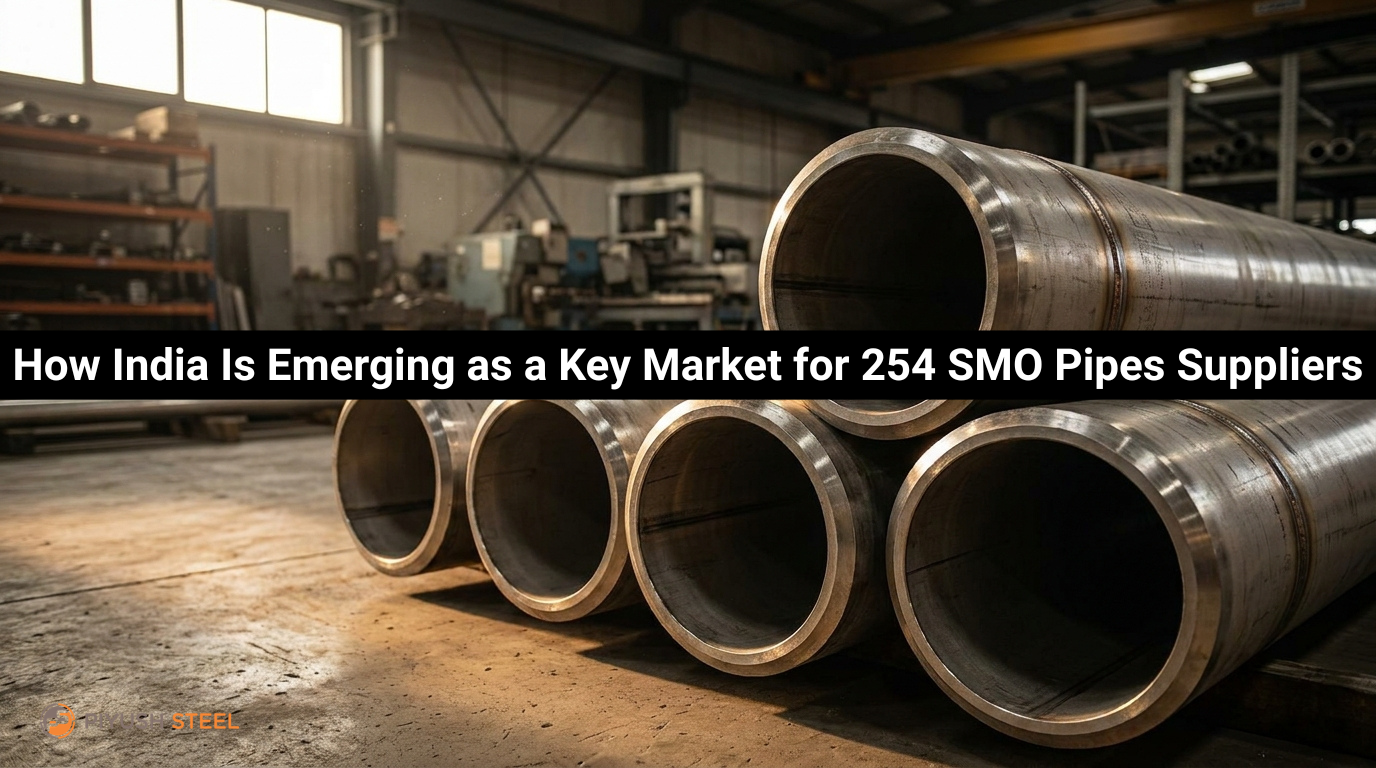
254 SMO pipes are a super austenitic stainless steel grade used where standard grades corrode and fail. High chloride exposure, seawater contact, and aggressive chemicals are the conditions this material is built for. Global demand has grown, and India has become a practical sourcing option for buyers who need reliable 254 SMO pipes manufacturer options at pricing that works.
What Are Stainless Steel 254 SMO Pipes?
254 SMO contains around 20% chromium, 6% molybdenum, and added nitrogen. This composition gives it strong resistance to pitting and crevice corrosion in chloride-heavy environments where standard stainless grades break down. Most other grades simply don’t last under those conditions.
It also carries good tensile strength, so it holds up under mechanical stress and chemical exposure at the same time. That’s why engineers specify it for long-term installations. Replacing piping frequently in these environments is not practical, and this material reduces that problem considerably.
Chemical processing, offshore oil and gas, desalination, pulp and paper and power generation are the industries where 254 SMO pipes are regularly used. Sustained contact with seawater, acids, or oxidizing chemicals is where this grade performs reliably.
Growing Demand for 254 SMO Pipes in India
India’s chemical processing industry has grown a lot in the last ten years. Plants that work with sulfuric acid, phosphoric acid, and similar chemicals need pipes that can resist corrosion for many years. As these plants have increased their capacity and built new units, they are buying much larger volumes of this kind of piping. Offshore oil and gas activity has added to this. Subsea pipelines and offshore platforms require material that holds against seawater exposure through years of continuous operation. India’s own offshore projects, alongside export contracts into the Middle East and Southeast Asia, have kept this demand consistent.
Desalination and government-backed infrastructure projects have driven further consumption. Water treatment and industrial development schemes have increased the need for high-grade piping across multiple regions. Buyers evaluating suppliers should review detailed product data, such as 254 SMO pipes stock size range and specifications to confirm the material fits actual project requirements. Domestic manufacturing initiatives have also helped Indian producers scale up output to meet this rising demand.
India’s Strength as a Manufacturing Hub
Indian producers have built real capacity in high-grade stainless steel pipe manufacturing. Modern equipment, skilled workforce, and established supply chains make India a workable sourcing option for buyers across multiple regions.
Advanced Production Capabilities
Equipment for melting, forging, and finishing has been upgraded across many Indian facilities over recent years. Manufacturers have invested in production capabilities that can handle international order volumes and tighter specifications. Engineers with metallurgical backgrounds manage production directly, which keeps quality control closer to the process.
Competitive Pricing Advantage
Production costs in India are lower than in Europe and North America. For buyers placing bulk orders, this difference is significant. Manufacturers can price competitively without dropping below the quality benchmarks that industrial applications require, and larger volumes reduce per-unit costs further.
Export-Oriented Growth
Indian manufacturers now supply regularly to Europe, the Middle East, and Southeast Asia. Several have built dedicated export teams to handle international orders efficiently. More global buyers are adding Indian suppliers to approved vendor lists, and this trend has been steady over recent years.
Role of 254 SMO Pipes Manufacturers in India
Most Indian manufacturers follow ASTM and ASME production standards and hold third-party mill certifications. For international buyers, this documentation is typically a procurement requirement. Established suppliers understand this and maintain the paperwork accordingly.
Customization is available from most suppliers. Non-standard dimensions, specific end finishes, and particular surface treatments can generally be handled without excessive lead times.
Projects with particular demands do not necessarily have to wait through long manufacturing cycles. Stock is kept for standard sizes with larger manufacturers, and rapid delivery may often be available. Well-planned delivery schedules for bulk procurement are usually an option, allowing project teams to plan around realistic timelines with minimal back and forth.
Key Applications Driving Market Growth
Oil and Gas Industry
Offshore platforms and subsea pipelines use 254 SMO for its resistance to chloride-heavy seawater. These environments involve years of continuous exposure, and frequent material replacement is simply not viable.
Desalination Plants
Brine and seawater contact makes standard stainless grades impractical for desalination use. 254 SMO handles pitting and crevice corrosion under these conditions reliably, which is why it appears consistently in desalination project specifications.
Chemical Processing Industry
Reactors, heat exchangers, and transfer lines that handle strong acids or oxidizing chemicals need material that holds up over time. 254 SMO is a standard fit for these applications across most chemical processing facilities.
Power Generation Sector
High-temperature and high-pressure systems involving seawater cooling use 254 SMO for critical piping. Material failure in these systems has significant operational consequences, so specifications are followed carefully.
Quality Standards and Certifications
Indian manufacturers comply with ASTM A312 and ASME standards covering chemical composition, mechanical properties, and dimensional tolerances. This is a common expectation for industrial buyers.
Production testing covers mechanical testing, chemical analysis and corrosion resistance evaluation. Hydrostatic or non-destructive testing can be arranged according to application. Most established manufacturers handle this without difficulty.
Material test reports and third-party inspection certificates are standard in international trade. Buyers in regulated industries need this documentation for their own compliance process, and most Indian suppliers provide it routinely.
Challenges in the 254 SMO Pipes Market
There are real, ongoing challenges in this market that both buyers and suppliers deal with.
- Raw material price: Molybdenum and nickel prices depend on the global supply situation. Therefore, production costs cannot be predicted and long-term pricing becomes a problem for buyers and suppliers.
- Volume quality consistency: The large runs of high-alloy grades require tight process control to prevent variation in mechanical or chemical properties. Not every manufacturer manages this reliably across all order sizes.
- Competition from other countries: China and South Korea both produce 254 SMO pipes and compete actively in the same international markets. Indian manufacturers have to stay competitive on price and quality assurance together to hold their position.
Future Outlook of 254 SMO Pipes Market in India
Investment in energy, water infrastructure, and chemical processing is expected to continue growing in India and across export markets. This keeps demand for high-performance piping materials stable for the foreseeable future.
Export opportunities are growing as more global buyers approve Indian suppliers. This steady change shows rising trust in India’s production quality, not just low prices. Production technology is improving as well. Better quality control systems and more precise finishing capabilities allow manufacturers to take on tighter specifications and higher-value orders over time. This positions India’s 254 SMO supply capacity to grow in scope, not just volume.
Choosing the Right 254 SMO Pipes Manufacturer
Experience is the first thing worth checking. A manufacturer with a real history in 254 SMO supply will have process knowledge and quality controls that newer suppliers are still building. Past client references and the industries they have served tell you more than any product catalogue.
Certifications and documentation need to be verified before orders are placed. ASTM compliance and mill test reports are standard requirements for most industrial applications, third-party inspection is also necessary. While cost is important, you also need to evaluate production capacity and delivery schedules. A supplier who consistently meets deadlines is more valuable than one who offers the lowest price but fails to deliver on time.
Manufacturers with in-house technical support are prioritized so material selection questions and specification issues can be addressed directly, avoiding delays and miscommunication further down the project.
Conclusion
India’s position in the global 254 SMO pipes market has grown over recent years, supported by real manufacturing capacity, international certifications and competitive pricing. Domestic demand and export activity both point toward continued growth in this segment. Cost, customization, and supply reliability are practical advantages for buyers from Indian manufacturers. Buyers can minimize complications from procurement to project completion if they choose a supplier with verified certifications, sufficient production capacity and a proven track record.