

Flanges play a critical role in the oil and gas industry by providing secure, leak-free connections for pipelines, valves, pumps, and other equipment. These mechanical components allow for easy assembly, disassembly, and maintenance, all while ensuring high-pressure and temperature capabilities in challenging environments. The types of flanges in oil and gas differ in design, material, and application based on specific operational requirements. At Piyush Steel, we specialize in high-quality flanges designed to meet the rigorous demands of the oil and gas sector. Here, we explore the various types of flanges in oil and gas, their applications, and their advantages.
1. Weld Neck Flanges
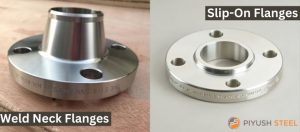
Weld neck flanges are among the most commonly used types of flanges in oil and gas due to their strength and ability to withstand high-pressure applications. Weld Neck flange type features a long neck that gradually tapers to a pipe, which is then welded, offering excellent stress distribution. Weld neck flanges are ideal for situations where high integrity, particularly in pipeline systems, is crucial. They are often used in critical, high-pressure systems such as in offshore drilling operations or in oil refineries where reliability and durability are of utmost importance.
2. Slip-On Flanges
Slip-on flanges are another popular choice in the types of flanges in oil and gas because they are easy to install and offer a cost-effective solution. These flanges are designed to slip over the pipe, after which they are welded both inside and outside for a secure connection. They are frequently used in lower pressure applications where ease of assembly is prioritized over maximum strength. Slip-on flanges are commonly found in oil and gas pipeline systems, particularly in transport systems where quick installation and replacement are necessary.
3. Blind Flanges
Blind flanges are used to seal the ends of pipes, valves, or other equipment to ensure no fluid leaks out. As the name suggests, these flanges do not have a central hole and are used for capping off lines or vessels that are not in use. They are essential in maintenance or shutdown scenarios in the oil and gas industry, where isolating certain sections of the system is required. Blind flanges are designed to withstand high pressure and prevent system failure, making them one of the vital types of flanges in oil and gas.

4. Threaded Flanges
Threaded flanges are widely used when welding is not a viable option, such as when dealing with smaller pipes or systems that are prone to stress or vibration. These flanges have threads on the inside, allowing them to be screwed onto corresponding threaded pipes. While not suitable for high-pressure applications, threaded flanges are commonly used for low-pressure oil and gas systems, including those found in offshore platforms and in the chemical processing sector where ease of installation is critical.
5. Socket Weld Flanges
Socket weld flanges are designed to be inserted into the pipe socket and welded around the circumference, providing a robust and secure connection. They are used in systems where high pressure and low fluid temperature are encountered. Socket weld flanges are typically found in smaller diameter piping systems in the oil and gas industry. They are known for their strength and durability, making them ideal for high-stress applications in refinery processes, offshore oil rigs, and gas processing plants.

6. Lap Joint Flanges
Lap joint flanges are designed with a loose flange that fits over a stub end welded to the pipe. This allows for easier alignment and rotation of the pipe during assembly, making lap joint flanges ideal for applications that require frequent disassembly, such as in maintenance-heavy oil and gas systems. They are typically used in non-critical applications, such as in pipelines where disconnection and reconfiguration are needed regularly. They also offer the flexibility to accommodate different pipe sizes, making them versatile for use in a variety of operational scenarios.
7. Orifice Flanges
Orifice flanges are designed to measure the flow of fluids within pipelines. These flanges have a hole through which a differential pressure measurement device can be placed, enabling the monitoring of flow rates in oil and gas pipelines. Orifice flanges are commonly used in metering systems and flow measurement devices in the oil and gas industry. They are essential in ensuring that operations are running efficiently, and they provide valuable data for performance monitoring and maintenance planning.

8. Expanding Flanges
Expanding flanges are used in applications where the pipe diameter increases at the flange connection. These types of flanges in oil and gas are designed to facilitate pipe connections that transition between different pipe sizes without compromising the integrity of the system. Expanding flanges are often used in piping systems where there are changes in pipe size due to flow requirements or when additional equipment, such as pumps or compressors, need to be added to the pipeline.
9. Rigid Flanges
Rigid flanges are designed to be extremely strong and are primarily used in applications where high resistance to internal pressure is required. These flanges do not allow for any axial or angular displacement and are typically used in situations where the safety and stability of the pipeline are crucial. Rigid flanges are common in high-pressure and high-temperature systems, such as in subsea oil extraction pipelines or in gas processing plants where the integrity of the connection is paramount.

10. Raised Face Flanges
Raised face flanges are among the most commonly used types of flanges in oil and gas because of their ease of use and cost-effectiveness. These flanges have a small raised area around the bore that helps create a better seal between the flange and the gasket. This raised face improves the sealing ability and is widely used in both low- and high-pressure oil and gas pipelines. They are frequently used in pipelines, compressors, and gas treatment plants where high pressure and fluid control are essential.
Conclusion
Flanges are essential components in the oil and gas industry, facilitating secure, leak-proof connections in a wide range of applications. The types of flanges in oil and gas vary in design, material, and purpose, each tailored to specific operational requirements. From high-pressure systems to simple pipeline connections, choosing the right flange ensures the safety, durability, and efficiency of the entire system.
At Piyush Steel, we specialize in providing a variety of flanges, including weld neck, slip-on, blind, threaded, and socket weld flanges, all designed to meet the demanding needs of the oil and gas industry.