
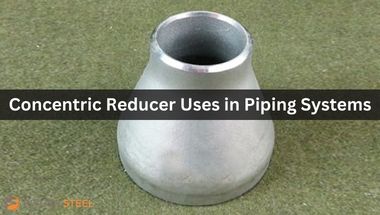
Concentric reducers maintain hydraulic efficiency by changing the diameters of the pipes to regulate the velocity of flow and the pressure distribution. In verticals oil, gas, and power transmission pipelines, they maintain centreline alignment, thus ensuring stable flow characteristics. While eccentric reducers with flat side up are recommended horizontal pump suction lines, to avoid vapour accumulation.
In chemical and water treatment plants, concentric reducers facilitate the integration of equipment components of different sizes in compact, high-pressure modular systems. This guide outlines their applications, mechanical advantages, and selection criteria for high-performance process conditions.
What Is a Concentric Reducer?
A concentric reducer is a cone-shaped pipe fitting with both the large-bore end and the small-bore end share the same centerline. The reduction in size of bore is uniform around the full circumference with inlet and outlet ends are aligned on the common longitudinal centre line, having no flat side. Its symmetrical flow makes it ideal for vertical lines and high-velocity discharge systems..
In contrast eccentric reducers have offset centerlines and flat faces for horizontal pump suction lines. Concentric reducers are recommended where centreline alignment is required, such as vertical pipelines, manifolds, and in-line process connections. Material selection depends entirely on the corrosivity and temperature of the media. Common specifications include ASME B16.9 for wrought buttweld fittings.
Concentric reducers are manufactured in:
- Stainless steel: 304, 304L, 316, 316L, 321, 347
- Carbon steel: ASTM A234 WPB / WPC
- Alloy steel: P11, P22, P91 for elevated-temperature steam service
- Duplex and super duplex: 2205, 2507 for corrosive and offshore environments
Primary Concentric Reducer Uses in Piping Systems
A) Connecting Different Pipe Sizes
Concentric reducers are used to connect bores of various diameters while maintaining a common centerline. These reducers ensure a smooth transition of the pipe bore with low pressure loss and predictable hydraulic performance in vertical and in-line piping systems.
B) Pump Suction and Discharge Lines
We also use it in the vertical suction and discharge lines of pumps. In vertical installations, air pockets do not form as they would in horizontal installations, thus preventing cavitation and protecting the impeller of the pump from mechanical damage
C) Process Piping Systems
Chemical plants and petrochemical companies require accurate flow control to control chemical reactions. We supply these fittings to ensure that the process media moves through the system at the calculated Reynolds number. Symmetrical reduction prevents the accumulation of sediment.
D) HVAC Systems
Flow adjustment is a constant requirement in ducting and piping for climate control. Concentric reducers are used to regulate the velocity of air and water in the utility systems. Right sizing avoids “whistling” sounds due to constricted air passages.
E) Water Treatment Plants
Pressure and flow regulation are mandatory in desalination and municipal water facilities. Corrosion-resistant reducers that can support rapid processing. The reducers ensure that filtration units get water at the correct pressure.
F) Power Plants
Steam and condensate lines operate under extreme thermal transients. Eccentric reducers (flat-on-bottom) are preferred for horizontal steam lines to prevent condensate pooling and water hammer, while maintaining a straight axis. This reduces the mechanical load on pipe hangers and supports. Alloy steel grades — P11, P22, and P91 — carry the ASME pressure-temperature ratings required for lines operating above 400°C, where carbon steel grades lose their rated strength.
Advantages of Using Concentric Reducers
The major advantage is the smooth transition of flow due to the symmetrical cone design. This type of design reduces turbulence as opposed to other designs that involve a sudden change in diameter. Along with better flow, we see improved pressure distribution across the fitting walls. Installation is straightforward because the centre line does not change. This simplifies the design of pipe racks.
Then there’s the cost-effective nature of these fittings. They provide a high-strength transition without the complexity inherent in custom-fabricated offsets. As the load is in imbalance, concentric reducers are the only safe choice for vertical flow applications. They prevent the “cantilever” effect on supports that eccentric reducers might cause in a vertical run.
Why Choose Piyush Steel for Concentric Reducers?
At Piyush Steel, we manufacture concentric reducers in stainless steel, carbon steel, and high-strength alloy materials, all in compliance with ASME B16.9 and relevant ASTM specifications. We use CNC machining capabilities which provide precise control over wall thickness and concentric bore location, and our metallurgical processes are designed to provide improved resistance to pitting, crevice corrosion, and stress corrosion cracking in challenging service environments. Additionally, custom fabrication capabilities are available for non-standard and heavy-wall geometries that are well-suited for complex high-pressure process applications.
We also provide custom fabrication services for non-standard dimensions and heavy-wall configurations for complex high-pressure process applications. We offer assured delivery schedules and competitive pricing for both domestic and global markets. Each production lot is supplied with complete material traceability and full Mill Test Certificates (MTC) to verify pressure boundary integrity.
Conclusion
The use of concentric reducers is the most effective way to manage bore transitions while maintaining the structural centre line of a piping system. Proper selection prevents flow disruptions and protects expensive downstream equipment like pumps and turbines. We at Piyush Steel provide the engineering depth required to select the correct metallurgy and pressure rating for your system.
Your next step is to submit your technical specifications to our engineering team for a full review. Contact Piyush Steel for a formal quotation or to discuss custom fabrication for your upcoming piping project.